Showing posts with label methodology. Show all posts

Tuesday, February 22, 2011

Fatal instruction -- final instruction before application

What decision led to the fatal event? What decision, put into contact with an existing desire, launched the fatal accident into the object's becoming?

From Ulmer's last email (see last post): The decision was not to pollute but to trade.
Applied to my context: The decision was not to pollute but to ____.
Calculate? See?
I guess it depends on which element of E-Waste we're talking about.
If we start looking into the history of computing technologies, especially as they applied to Von Neumann in Poundstone, we can see a desire for an object capable of replicating Von Neumann's own, strange, mechanical ability to calculate. So, if we were to go with this thread, we might say that the decision was not to pollute but to calculate. To achieve this then, the materials used in the computer (particularly the non-ferrous metals we talked about before) simply are tools used to enable the connections necessary to manipulate the binary code into something capable of calculating.
But hold on a second. We've so far associated E-Waste with a sense of virtuality, and while the cathode ray technology doesn't define the computer as such, it may act as a successful relay between the computer's functions and our experience of it (an experience defined by the computer's ability to offer us a graphic iconic interface, to display pictures, to act as a window to the world). So, sticking with the cathode ray momentarily, we can see a need emerge.

The historical fatality we can see is the necessity for us to have a relay to the computer's functionality. Punch cards, floppy disks: they're all benign compared to an intrinsic need to see calculation, text, etc. through familiar images.

When you have this need, one can see the necessity of this determination. One had to see. The decision was not to pollute but to see. The involvement of non-ferrous metals (but lead particularly) in the production of the cathode ray tube was simply a technical intervention satisfying a deeper desire. So, therefore, the desire to see fixates on these metals as a means to deliver the object, to intertwine our destiny with its.

Additionally, one can see the problem of E-waste arising from this necessity to see as well. We can see the development of subsequent screens (LCD, LED) as resulting from a desire to see ever more clearly, resulting in the displacement of the CRT and its eventual demise as a figure in a landfill. That isn't to say that these newer technologies solve the problem. A report has indicated that LCD's still contain dangerous amounts of copper and lead. Another indicates about the same for LED screens.

What emblem can stand for this?

Part of my early posts attempted to account for the mixtures of outdated technologies with human desires to see, now expressed in different ways (fetishizing of VHS or cassette tapes in an era of DVD and digital images).
So, from an earlier project that used diffusion as a means to get across the issues of E-waste, perhaps we can add to that a dimension of a kind of seeing that has changed. I.E. IN a new image, we can put in formal elements of former ways of seeing.
My graduate thesis focuses on classical figures by which cinema has been understood (particularly the window and the mirror, the cinema is a ____). My move is to synthesize these forms and posit the cinema as a reflecting window, one that, for example, offers a window onto reality but also that reflects cultural associations, one that offers a window onto the world but also reflects the digital nonsense of pure symbolic, etc. etc.
Perhaps we can utilize this model for the image. The image will offer us a window onto E-Waste but reflect the modes of seeing that have produced the E-waste.
This doesn't change the image much, but it focuses it. From a pure depiction of E-waste, we must now integrate screens (see my "vertigo" image) but also their ability to signify simply as an apparatus.

How can this emblem be manipulated to show the universal subject its own image in the mirror?

We'll see the emblems of E-waste, manipulated to show us texture and diffusion.
But we'll see our mirror image in the scan lines and distortions (simulated, of course) associated with the CRT.

Instruction:

Tap into our fatal need to see that incorporates the poison of the earth. Use the experience of image + the images itself to get across these ideas of seeing oneself in those things that offer images.

As a formal technique, we might see these scan lines as doing something like Holbein's Ambassadors painting:
Lacan writes that this is a prime example because, looking into the image, we eventually see the death's head. This connection will need to be explored more, but I'm starting to intuit its potential.

Let's give it a try.

Monday, February 14, 2011

Provisional sketch of new image (Parts 1 & 2)

a) the accident reveals the substance
b) follow the accident
1) Conceive the accident as sign
2) Model the accident onto object in pop narrative
3) Put yourself in the shoes of accident-as-commodity

1) E-Waste as sign involves processes of displacement and diffusion. Most of the imagery of E-Waste I've seen are perversely beautiful due to the sheer accumulation of wires, empty computer husks, etc. But its actual method of accident (ecological and biological damage) has primarily involved processes of chemical diffusion: the diffusion of lead, beryllium, cadmium, etc. from the computer products into the lungs of workers and into the earth over which they're burned or otherwise destroyed. The process into a sign must take these things into account. So, we may have a layering of the earth, the biological, and diffusion. Some methods have already been tried at this, some in the right direction and some in the wrong. But now, as a sign, we can develop an abstraction, something reveling in signifiance, something able to get across the obscure feeling, bringing together its obscure desire for us to experience it vicariously. Layering, dissolving, and trailing will be our strategies in this.

2) As I did a few posts ago, the accident is modeled on the object of Vertigo. In that film, Jimmy Stewart attempts to get back many things: his manhood, his balance, his occupation, etc. But all of those things become wrapped up in the love interest, his romantic obsession with the deceased Madeleine. Judy offers him the key to regaining his lost love and all of the symbolic material that comes with her, but the twist is that, as donor, Judy is also the object. Judy eventually encourages Stewart to take her as object, to allow him to wrap her up in his own obsession. At the end of that post, I concluded that E-Waste as sign and computer at object should encourage us to do the same: experience me as object, wrap yourself in my virtuality. Yet the object takes its revenge, infecting our bodies, revealing a different desire: to become one with us. To step outside of its virtuality and to merge somehow. So far, it's been through diffusion.

Provisional sketch of new image (parts a & b)

a) The accident reveals the substance
b) Follow the accident
1) Conceive of the accident as a sign
2) Model the accident as object onto a pop-narrative
3) Put yourself in the shoes of the accident-as-a-commodity

a) E-Waste tells us something about the computer and our relationship to it (its technics). Its fundamental mystery (we have yet to tangibly experience it or its results) is that E-Waste has nothing to do with our experience of the computer-as-machine. As a machine, it provides us with a virtual interface, an interface represented by (at least) a double negation.
First, our interfacing with the machine presents us with iconographic registers that are instantaneous with our interaction and manipulation of them. Its essential work, of course, takes place at the level of code. Second, this code itself remains a virtual network, entirely supported by a purely symbolic system of notation having no relationship with the referent. But this code itself only works as a result of the various tangible parts of the machine, parts that produce certain chemical reactions to fire electronic messages in and through lines.
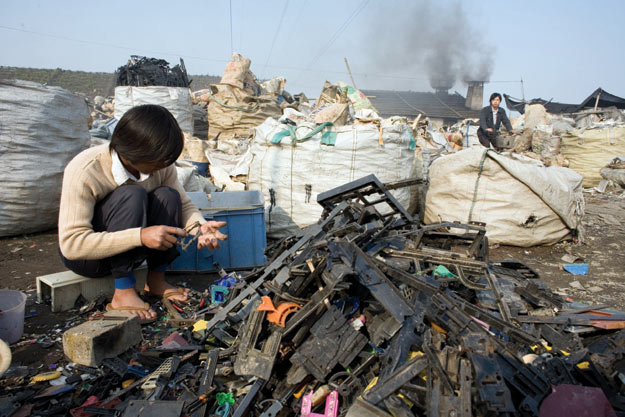
E-Waste reverses the order, stopping short before the first negation can be reached. Unwired and cut off from our normal relationship, we see the obscenity of the machine, smashed into bits, and this is where the machine has its revenge. It allows us to see its insides but only at the price of ecological and biological damage, conveniently displaced from first world consumers to third world scrap-metallers.

b) So what we're left with is another kind of displacement or negation. The machine is used, used until it quits (or until we quit it). We tell the machine, "I got what I wanted, baby, hit the bricks!" And it does, moving on to new users but eventually being pressed to other areas who can employ its physical material, themselves having value on a virtual level (so, a kilo of copper might fetch some $$$). We're there seeing the more virtual than virtual, of course lapsing into its reverse state: the real, or reality. From these compounded virtual relationships, real consequences develop...for some. This may not be just the limit for the particular object but may be considered the limit for a larger virtuality, the ones of exchange (reaping all sorts of ecological havoc) and of interfacing (disconnecting us further from the real). But let's see how much further it can go.

Sunday, February 13, 2011

Analyzing the disaster below

On pg. 75, Baudrillard gives us one of our prime directives in a fairly direct manner: "Against the true of the true, against the truer than true . . . against the obscenity of obviousness, against this unclean promiscuity with itself that we call resemblance, we must remake illusion, rediscover illusion,t his power, at once immoral maleficent, to tear the same away from the same, called seduction. Seduction against terror: these are the stakes. There are not others."  Okay, fine, fighting terror with seduction. Remaking illusion, yadda yadda yadda.  I had a failed project at creating an image this morning. The essential idea would have been to layer the natural, the biological, and cartographic on the same plane and then attempt to map out E-waste. I keep on returning to the figure of the map because of the problem's geopolitical implications, something I can't help but identify as one of the primary scenes of the accident.  Anyway, my attempt was pretty abortive and resulted in a wasted, albeit fun, half-hour.  SO, looking at this page in Fatal Strategies, I find my eyes drawn to another segment that I think can help me clear this up:  "Illusion is not false, for it doesn't use false signs; it uses senseless signs, signs that point nowhere. This is why it deceives and disappoints our demand for meaning, but it does so enchantingly."  I had the right idea in the beginning, bringing together the natural, the biological, and the cartographic as a means to produce a background not quite recognizable but still resembling...something.  Where I messed up was in creating these tokens of the event. These signs point somewhere. We want signs that point to nowhere, senseless signs that can help us squeeze a new logic into the insanity of rational structure. So, I guess I just realized that I should have taken Ulmer's clue earlier and gone for more or less total abstraction sooner rather than later? 

Wednesday, January 26, 2011

Provisional Image(s)


Image 1

Image 2

Okay, so here are a couple reachings at figuring out this image.

Working from these images:
Binary Code created on Word

I then put them into my digital camcorder (I like the scan lines) and then put them into Final Cut. Using dissolves, I produced crosses between Forest and Waste, Waste and Videodrome, and Videodrome and the binary. Then, in Photoshop, I layered the images, adjusting opacity and isolating a layer on the right for the hand and binary on the screen.

I then did another version with the E-waste stuff in the foreground and adjusted a bit to allow it more visibility.

Not sure which I prefer. The first one looks better, but the second one has more going on. I'd like to redo this using my own images. I obviously can't produce my own E-waste images, but the forest, a Videodrome-esque shot, and the binary can all be done very easily. So I guess let's consider this a prototype

Wednesday, January 19, 2011

Not even a provisional image, but a provision of a provisional image


During my first semester, I did a Powerpoint presentation on the use of modernist and industrial architecture in Antonioni's Il Deserto Rosso (1964). I was taking screencaps using VLC Media Player and found that scanning back and forth through the .avi file (the film was not yet available on R1 DVD, so I pirated a Russian DVD rip) often produced these bizarre layerings of imagery and digital distortion. I started taking caps during these short instants of distortion (the program would quickly correct these layerings, so you had to be very quick to grab them before they disappeared), and this one really struck me as a nice exemplification of the film's take on the violence of industrial Ravenna on the films' protagonists' subjectivities.

Unfortunately, an update to VLC all but nixed this effect, and I haven't been able to control the glitch to grab more of these great images (that's what you get when you rely on contingency for effects). Anyway, I'd like my image to take on these kinds of qualities, for the layering of different regimes of images really works, I think, to produce abstractions of otherwise transparent imagery.

My current plan is to utilize video editing cross dissolves in order to produce some kind of image. If one takes a still in the midst of the cross dissolve, one gets an intermediate image, often with blurred contours and cross-bleeding.

But what will these elements be?

Right now, I'm thinking it through in these ways:

1) E-Waste as a concept thrives on a disconnect between our virtual experience of computer hardware/software and the organic natural world. So, the first condensation will be between virtual/real worlds (my master's thesis also concerns these topics, so they've been rattling around the brain for awhile).

2) Yet, the issue is that our experience...well, my experience involves the simulacrum rather than the tangible hardware. That's, of course, part of why the problem occurs. So, I guess the image would have to also deal with the disjunction between the material devices producing my experience (probably while they're poisoning organic beings) and experience of actually using these things.

So, what I'm trying to do is to produce an image that involves: the natural world, the decaying electronics, and their juxtaposition to the regime of memory and GUI's.

Using dissolving techniques, I could ostensibly produce a kind of blurred image, approaching abstraction. BUT I'm not sure I want to go into full abstraction...the question then is how to negotiate visual force without losing any semblance of the denotative power of images...

Another memory I have from that course was working with Wilhelm Worringer's Abstraction and Empathy (1907), a text that sets Eastern (abstract) art against Western (realist) art. It suggests that art turns to abstraction to express comfort with indeterminacy and that realism can be taken as a sign of a culture's needing to assert its control over reality. Perhaps in our project of taking on an incredibly indeterminate time, we need to turn to abstraction as a way to reflect a growing comfort with indeterminacy. Maybe my desire to maintain some recognized imagery of the world reflects a discomfort with embracing indeterminacy.

Maybe I can pursue something akin to Kristeva's notion of signifiance, a term used to indicate something that falls between the signifier and the signified. Maureen Turim uses this as a key structural principle in her first book, Abstraction in Avant-Garde Films, which is where I stumbled on it. She cites the North American avant-garde film movement of the 60's and 70's (often called "structural" film, I think Sitney came up with that term) as utilizing an indeterminacy between signification and nonsense as a key way of producing force in the image. Barthes uses the term too in Image, Music, Text but takes a different spin on it (basically saying that it's a way of understanding our reaction to photographs beyond any informational or discernible aesthetic applications). Anyway, the challenge would then be to harness the force of indeterminacy produced by an image that we can almost figure out.