Showing posts with label e-waste. Show all posts

Sunday, March 20, 2011

Like Jason, the Blog returns from the dead


or maybe more like Fritz Lang's Dr. Mabuse.

So, this post will be a little slap-dash, but we were making so much sense before that it'd be a shame not to re-energize the blog with some good old fashioned information sprawl.

So, I missed class on Wednesday, so this post will serve two purposes: 1) to report on my progress towards an image representing my disaster and 2) parsing the notes in that context in order to arrive at something like a plan for part 2.

Section 1:

So, working from my previous failures, I created a new image:

Clearly, we're not quite there yet, but we're making progress all the same.

Okay, so what we have is an image of a computer emanating multi-colored rays, those centered on an image of Sylvia Sidney, one of my favorite actresses. Why her? I guess it has something to do with...er...seduction (ahem). Outside of the computer, we see E-waste that gives texture to the colored sprawl. Finally, we have static running over the image.

The problems: Sidney's not the emblem we need here. She's evocative, to be sure, but we need something that pushes it in a different direction. I'm thinking Mabuse might be an image to consider. Something from these below perhaps...


I especially like the 2nd design.

Problem 2 is that the static isn't integrated terribly well as a formal strategy. Don't know what I was thinking there, but I layered and saved the image without creating another copy, so it's there for keeps. I'm thinking I'll start from scratch again anyway. I like a lot of it, but the colors need touching up.

Section 2:

John was nice enough to send me his well-organized notes, and I'd like to highlight some of what seem like the key points. I'll go through them and then organize a paragraph or something highlighting what I'd like to do:

"Look at your accident as a festive event of vertigo"
I guess my earlier personification of the object attempted to do something like this. I think the key here might be to think of the production of E-waste not as a complicated network of geopolitical insanity resulting in physical poison but as a good time, as a party, as a festival.
So, what would have to be highlighted then is A) The joy of seeing appropriate to E-Waste and digital imaging. I think I might have this (the multi-color spiral giving us a "shinyness" that might help. B though) There's a joy in cracking these objects open, having been seduced into believing them the receptacle of our desire to see. We want to see through them, but eventually we also want to see in them. Do the images of E-Waste get at this? How do you get across the joy of destruction without motion or sound?

"Ethics of cooperation: why do people cooperate? (game theory addresses this from the dimension of the subject ('I think he thinks') -- it recommends defection). Why do people reciprocate in the gift economy? (belief in the 'Hau'). Fatal Strategies thinks, more ecologically, from the position of the object/event. The accident/disaster is the object's reply to the subject."

So, why would people cooperate in an electrate society? Well, we're not concerned with subjects; we're concerned with the will of the object. Why does the object cooperate? Well, in the accident, it doesn't. So, I guess the exchange might go something like this (for my disaster):
Subject: I want to see.
Object: Here ya go.
Subject: I want to see better. See you later.
((at this point, the object is set into motion, moving overseas or into a landfill))
Subject B: I want to see too!
Object: Here ya go.
((smash smash))
Subject B: *cough**cough*
Object: Hey, pal, you wanted to see. Don't get mad at me.
So, I guess the desire for the object might be to sustain its seduction as long as possible, by infiltrating the subject, if necessary.

"Use one thing to say something about something else, use the 'outside' to say something about the 'inside'"

I think if I can somehow get across the logic of visual media (in its constant improvement/replacement), the seduction (with Mabuse/visual pleasure), and the consequence (the production of E-Waste and the obscenity of visibility), perhaps I can get at something having to do with an innate desire to see.

"Beauty no longer applies as the measure -- now it's closer to the absurd or the sublime"

Exactly my logic in using Mabuse over Sidney. Sidney's beautiful; Mabuse's grotesque but grabbing. The logic of the image would be to abstract the power of imagery via sublime coloration.

One more point:
Near the end of John's notes, he talks about the musical slope of language and speaks to our project's relationship to psychoanalysis. A potential question for email: how does this relate to our sense with working w/ images? That is to say, we could think of some of the ways in which written or verbal language might create chains of displacement or condensation and, in that way, trace back a symptom (that's pretty much Lacan's take, more or less). But we're working with visual images. Do we rely on iconographic resemblance? Symbolic resemblance? Affective resemblance (a little more open)?

Tuesday, February 22, 2011

Fatal instruction -- final instruction before application

What decision led to the fatal event? What decision, put into contact with an existing desire, launched the fatal accident into the object's becoming?

From Ulmer's last email (see last post): The decision was not to pollute but to trade.
Applied to my context: The decision was not to pollute but to ____.
Calculate? See?
I guess it depends on which element of E-Waste we're talking about.
If we start looking into the history of computing technologies, especially as they applied to Von Neumann in Poundstone, we can see a desire for an object capable of replicating Von Neumann's own, strange, mechanical ability to calculate. So, if we were to go with this thread, we might say that the decision was not to pollute but to calculate. To achieve this then, the materials used in the computer (particularly the non-ferrous metals we talked about before) simply are tools used to enable the connections necessary to manipulate the binary code into something capable of calculating.
But hold on a second. We've so far associated E-Waste with a sense of virtuality, and while the cathode ray technology doesn't define the computer as such, it may act as a successful relay between the computer's functions and our experience of it (an experience defined by the computer's ability to offer us a graphic iconic interface, to display pictures, to act as a window to the world). So, sticking with the cathode ray momentarily, we can see a need emerge.

The historical fatality we can see is the necessity for us to have a relay to the computer's functionality. Punch cards, floppy disks: they're all benign compared to an intrinsic need to see calculation, text, etc. through familiar images.

When you have this need, one can see the necessity of this determination. One had to see. The decision was not to pollute but to see. The involvement of non-ferrous metals (but lead particularly) in the production of the cathode ray tube was simply a technical intervention satisfying a deeper desire. So, therefore, the desire to see fixates on these metals as a means to deliver the object, to intertwine our destiny with its.

Additionally, one can see the problem of E-waste arising from this necessity to see as well. We can see the development of subsequent screens (LCD, LED) as resulting from a desire to see ever more clearly, resulting in the displacement of the CRT and its eventual demise as a figure in a landfill. That isn't to say that these newer technologies solve the problem. A report has indicated that LCD's still contain dangerous amounts of copper and lead. Another indicates about the same for LED screens.

What emblem can stand for this?

Part of my early posts attempted to account for the mixtures of outdated technologies with human desires to see, now expressed in different ways (fetishizing of VHS or cassette tapes in an era of DVD and digital images).
So, from an earlier project that used diffusion as a means to get across the issues of E-waste, perhaps we can add to that a dimension of a kind of seeing that has changed. I.E. IN a new image, we can put in formal elements of former ways of seeing.
My graduate thesis focuses on classical figures by which cinema has been understood (particularly the window and the mirror, the cinema is a ____). My move is to synthesize these forms and posit the cinema as a reflecting window, one that, for example, offers a window onto reality but also that reflects cultural associations, one that offers a window onto the world but also reflects the digital nonsense of pure symbolic, etc. etc.
Perhaps we can utilize this model for the image. The image will offer us a window onto E-Waste but reflect the modes of seeing that have produced the E-waste.
This doesn't change the image much, but it focuses it. From a pure depiction of E-waste, we must now integrate screens (see my "vertigo" image) but also their ability to signify simply as an apparatus.

How can this emblem be manipulated to show the universal subject its own image in the mirror?

We'll see the emblems of E-waste, manipulated to show us texture and diffusion.
But we'll see our mirror image in the scan lines and distortions (simulated, of course) associated with the CRT.

Instruction:

Tap into our fatal need to see that incorporates the poison of the earth. Use the experience of image + the images itself to get across these ideas of seeing oneself in those things that offer images.

As a formal technique, we might see these scan lines as doing something like Holbein's Ambassadors painting:
Lacan writes that this is a prime example because, looking into the image, we eventually see the death's head. This connection will need to be explored more, but I'm starting to intuit its potential.

Let's give it a try.

Monday, February 21, 2011

Fetish Object Methodology (a re-pressed email)

Hi everyone,

Dr. Ulmer's lecture the other day got me trying to think about my disaster's fetish object, some of which was recently documented on the blog.

I guess I just want to be sure I understand the idea behind the search for the object. Dr. Ulmer said it was a feature in reality that, when a particular process came into contact with it (ship-building, in his case), causes the fatal accident to come into being (the making of pine tar). For this particular disaster, the issue at hand is the little red mollusk, the initiator of a fetish that, should it be satisfied, ties the objects' becoming to the eventual accident.

So, the idea would be to trace the object back from the accident to figure how that accident came to be part of the object's becoming?

So, looking into my accident, I figured that the majority of the problems associated with e-waste come as a cause of mishandling the various non ferrous metals that figure in computer (or CRT) construction. Things like lead, cadmium, beryllium, mercury, etc. are released when these things are mishandled and then affect the local environment and workers. So, looking into where these things figure in construction, we see that, for example, lead figures a lot in the process of construction (it's in the solder, the protective coating of CRT screens, etc.).

I'm not sure where to go here. Intuition sends me to the various problems that these metals seek to solve (making connections, reducing a screen's glare, etc.) as the fetish, but that seems a bit weak and perhaps not specific enough. From the example offered by Dr. Ulmer, it seems as though the fetish object shouldn't necessarily be figurative and metaphoric but something tangible (a shoe fetishist would never say that her/his fetish involves, y'know, protecting one's feet).

Ulmer's Response (edited for my own personal use):
The philosophers of event want to get at that dimension of the world that "indicts" (categorizes) us. There is no transcendence on the machinic side; its evolution is entirely immanent.

The fatality of the contamination at the Cabot Koppers site in Gainesville is that, for it to be otherwise, there would have had to have been no wooden ships, no colonization of the New World, etc. Where is the "decision"? The decision was not to pollute, but to "trade" (economy, circulation of goods).

to presume that my being may be discovered only outside, in the world, made to appear in the mode of image (in whatever media).

We scan the outside materiality of our disaster to locate a fetish (a thing more than itself, the condenses in an emblem the necessity of the history handed down to us (the indictment: you are this).

You choose it, but the point is to think the inevitability, the necessity, of E-Waste. For example, if Einstein couldn't get his paper on relativity published, and got promoted to head of Customs and lost interest in physics, there maybe wouldn't be cathode ray tubes (nor nuclear energy) (I'm just blathering now).

Atomic physics is just one angle. You mention the metallurgy involved (the convergence of many inventions in the equipment) and that could serve just as well. In our context, we are addressing some aspects of the question of ethics raised in Game Theory, the principle that one cooperates or defects. That is thinking from the side of the subject. What is our ethics, from the side of the object?

E-Waste - an attempt at figuring out the fetish object


These two graphs come from UNEP's page on E-Waste, and while perhaps offering a wannabe obscene transparency in info (notice how the beginnings of the map don't show the sources), they have proven useful in figuring out exactly where the issue may lie. In the graph breaking down computer components, it becomes clear that all of the problems come as a result of these non-ferrous metals.

So, a possible avenue toward the fetish object at the heart of this thing might be to see what potential issues are solved via the use of these substances.

It seems as though lead is typically used in soldering, in the construction of CRT tubes (where it acts as a protectant against low-frequency electric fields and as a glare reduction layer).

==to be continued==

Sunday, February 20, 2011

A Virilio-ian exhibition


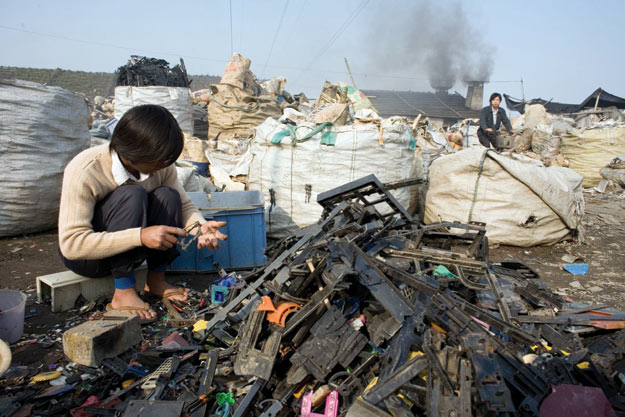
April 2008, Guiyu, China

A woman carries an electronic to be tossed onto a pile in Guiyu, which is, according to several sources, the largest E-Waste dump on earth. 80% of Guiyu's children have elevated levels of lead in their blood.

The purely virtual becomes filthy real.

Commentary on the object's "speech"

Looking back over the commentary this morning, I find that perhaps it went in the wrong direction toward the end. The object *wants* us to engage it in a virtual relationship. That's the teleology. The object wants us to forget that it's there (in this sense, the first few vignettes are okay).

But where I went wrong is in the section where the computer gets thrown overseas. This is part of its desire. This is part of its role as donor. So, the last few would go something like this.

"Hey, I'm glad that you're sending me away. We've had a great relationship, and I want to live on, if only in your memories of me." The object, of course, is being coy here. It wants us to send it to a virtual realm, distanced by time and the lack of image. What ends up happening though, is its trip into the obscene, into the exposing and decomposition of its working parts. It wants its guts to hang out for all to see, and this brings together a different kind of teleology that works toward a limit.

Its virtuality pushed to ecstasy, the object becomes more virtual than virtual: in a sense, perfectly in the real. It infiltrates the body and the earth itself, making for itself a new home inside the life and forces of the earth through diffusion. Pushed to its limit, we see a new teleology. Rather than wanting a virtual relationship, the computer, willing to give itself up to our desire (like Madeleine/Judy in Vertigo), the machine wants to merge. The digital will, it would seem, is to eventually converge (everything that rises must converge: one can imagine Watson the computer punching out the patronizing mother in the O'Connor story).

Hiding behinds its virtuality, the digital will to power lies in this ability to form relationships that are more virtual than virtual, that are real. The digital will seduces us with its virtuality to force its way into our bodies, into the earth, to become a world.

The digital will is in a state of becoming, its telos being that of a new world.

Saturday, February 19, 2011

Provisional sketch of a new image (part 3)

a) the accident reveals the substance
b) follow the accident
1) Conceive the accident as sign
2) Model the accident onto object in pop narrative

3) Put yourself in the shoes of accident-as-commodity

What is it that the accident says? I've decided to do an experimental sequence of dialogues in which I follow the object through its own narrative and life-span. I figure that providing a narrative might also help us with both Contrast and Theory at the same time, as well as giving voice to the sign came up with in the Target. I may be giving it too many human characteristics, but it's an experiment, so here goes nothing:

Narrative sequence: 1) Birth 2) Life 3) Exile 4) 1st Death 5) Afterlife

1) Taking place sometime after a computer or other electronic device has been brought home:
"Hello, I'm a Macintosh G-5. Turning me on is no problem (just press the button on my back). My protocols have made it super easy for you to get me up and running. Wait, hold on a second, buddy, would you...check...out...that...software!?! Isn't it great!? I know. Oh, what's that? You've never had a computer with a camera before? Check mine out. This is going to be a great relationship. Look, that's you in my screen. You look good; I look good; we'll be good together.

2) Hey man, glad you've been around so much lately. I'm running 6 programs right now (one of them, Transmission, the one you use to pirate those lousy VHS rips of Abel Ferrara television movies, has been on for 4 days straight). I've been running nonstop lately, but I don't mind. I'm digging the attention, to be frank. Aren't you amazed how easy I still am to use? Plug stuff in; I almost immediately recognize it and almost always start the software install before you even have to bother. You've got me set up just the way you like me. Check out how good that screen still from Gilda looks on this HD monitor. You don't know what's inside of me, and that's just fine. Our relationship's deeper than that. Look at these photos you took. Your niece was 14 months old then. She's five now. What a kid!

3) Oh please, baby, please, baby, please babybabyplease! We have a great thing going here! I stopped firing up right away awhile back, but you took me to the right people. My circuits and drives are fine now, baby. Sure, you had to buy a peripheral cd-drive. Did you hear me complaining all of those days you neglected to brush your teeth. Let's face it. You need me. I've been your $*#@&(%@(in' window to the world for 5 years now. You've learned more about yourself on and through me than with anyone else (except your wife...maybe). C'mon, man, get real. I've seen you checking out those Ipads. You think that thing can do what I do for you? C'mon, baby, I love you. I've always loved you! I've never made this relationship anything it isn't. C'mon, let's keep it going. Please.

4) Dear Todd,
That trip across the Pacific was bizarre. You remember that scene from Star Wars (I don't remember which one) where the gold robot goes into the Jawa cruiser thing and sees all of the dismantled robots? That's what this $*#&@#)er is like. I always figured we had a good thing. You should see some of these mean SOBs. Circuit boards pulled apart, wires hanging out, it's like their owners fancied themselves amateur surgeons. Thank God you never pulled on my insides.
All in all, I miss you, but I'm in a fun and exciting new space. We're sitting in a mound full of dirt and trash right now, but I have a bunch of friends from British National Health hangin' with me. I think they're putting up a volleyball net of some sort.
Oop, some kids are coming over. I wonder if they know how to play Tecmo Bowl. Will write back soon.

5) Todd,
A lot has passed since I last wrote. In fact, everything's changed. These kids here use hammers and saws and matches and, well, let's just say I'm a whole new person. Oop, did I say person? Well, kind of. You see, I'm actually punching this message up as I sit in this kid Ke-Zhang's left lung.
Okay, here's the story. Those kids came over and ravaged me. I mean, tore me to shreds. It was the most horrific thing that's ever happened to me. You, you were different. You were gentle with a capital G. No probings on my parts, no investigation into my workings, no nothing. These kids though, holy moly, they ripped me limb by limb and burned some of my coatings off in the fire. I guess I'm worth some money to them, like a fat American just waiting for his kidneys to get jacked.
Oh well, I didn't wake up in a bathtub full of ice.
I'm in a kid's lung.
In fact, I'm settling in.
I got a call from my cousin George. He didn't make it into anybody's lungs, but he's got a sweeter gig. He's moving down to a central water supply.
You see, we all made it. I thought having myself exposed would be the worst. Goodness would dictate that I remain in a strictly screened relationship, but these users, whoa boy, they wouldn't take no for an answer. Anyway, it all worked out in the end. Now, we're merging. They're cool with it. They cough sometimes, but, y'know, they did hammer me apart and set me on fire.
Anyway, I hope you and Steph are okay. I'm having fun and think I'm on to a whole new life now.
Let's just hope it lasts.


Monday, February 14, 2011

Provisional sketch of new image (Parts 1 & 2)

a) the accident reveals the substance
b) follow the accident
1) Conceive the accident as sign
2) Model the accident onto object in pop narrative
3) Put yourself in the shoes of accident-as-commodity

1) E-Waste as sign involves processes of displacement and diffusion. Most of the imagery of E-Waste I've seen are perversely beautiful due to the sheer accumulation of wires, empty computer husks, etc. But its actual method of accident (ecological and biological damage) has primarily involved processes of chemical diffusion: the diffusion of lead, beryllium, cadmium, etc. from the computer products into the lungs of workers and into the earth over which they're burned or otherwise destroyed. The process into a sign must take these things into account. So, we may have a layering of the earth, the biological, and diffusion. Some methods have already been tried at this, some in the right direction and some in the wrong. But now, as a sign, we can develop an abstraction, something reveling in signifiance, something able to get across the obscure feeling, bringing together its obscure desire for us to experience it vicariously. Layering, dissolving, and trailing will be our strategies in this.

2) As I did a few posts ago, the accident is modeled on the object of Vertigo. In that film, Jimmy Stewart attempts to get back many things: his manhood, his balance, his occupation, etc. But all of those things become wrapped up in the love interest, his romantic obsession with the deceased Madeleine. Judy offers him the key to regaining his lost love and all of the symbolic material that comes with her, but the twist is that, as donor, Judy is also the object. Judy eventually encourages Stewart to take her as object, to allow him to wrap her up in his own obsession. At the end of that post, I concluded that E-Waste as sign and computer at object should encourage us to do the same: experience me as object, wrap yourself in my virtuality. Yet the object takes its revenge, infecting our bodies, revealing a different desire: to become one with us. To step outside of its virtuality and to merge somehow. So far, it's been through diffusion.

Provisional sketch of new image (parts a & b)

a) The accident reveals the substance
b) Follow the accident
1) Conceive of the accident as a sign
2) Model the accident as object onto a pop-narrative
3) Put yourself in the shoes of the accident-as-a-commodity

a) E-Waste tells us something about the computer and our relationship to it (its technics). Its fundamental mystery (we have yet to tangibly experience it or its results) is that E-Waste has nothing to do with our experience of the computer-as-machine. As a machine, it provides us with a virtual interface, an interface represented by (at least) a double negation.
First, our interfacing with the machine presents us with iconographic registers that are instantaneous with our interaction and manipulation of them. Its essential work, of course, takes place at the level of code. Second, this code itself remains a virtual network, entirely supported by a purely symbolic system of notation having no relationship with the referent. But this code itself only works as a result of the various tangible parts of the machine, parts that produce certain chemical reactions to fire electronic messages in and through lines.
E-Waste reverses the order, stopping short before the first negation can be reached. Unwired and cut off from our normal relationship, we see the obscenity of the machine, smashed into bits, and this is where the machine has its revenge. It allows us to see its insides but only at the price of ecological and biological damage, conveniently displaced from first world consumers to third world scrap-metallers.

b) So what we're left with is another kind of displacement or negation. The machine is used, used until it quits (or until we quit it). We tell the machine, "I got what I wanted, baby, hit the bricks!" And it does, moving on to new users but eventually being pressed to other areas who can employ its physical material, themselves having value on a virtual level (so, a kilo of copper might fetch some $$$). We're there seeing the more virtual than virtual, of course lapsing into its reverse state: the real, or reality. From these compounded virtual relationships, real consequences develop...for some. This may not be just the limit for the particular object but may be considered the limit for a larger virtuality, the ones of exchange (reaping all sorts of ecological havoc) and of interfacing (disconnecting us further from the real). But let's see how much further it can go.

Sunday, February 13, 2011

Analyzing the disaster below

On pg. 75, Baudrillard gives us one of our prime directives in a fairly direct manner: "Against the true of the true, against the truer than true . . . against the obscenity of obviousness, against this unclean promiscuity with itself that we call resemblance, we must remake illusion, rediscover illusion,t his power, at once immoral maleficent, to tear the same away from the same, called seduction. Seduction against terror: these are the stakes. There are not others."  Okay, fine, fighting terror with seduction. Remaking illusion, yadda yadda yadda.  I had a failed project at creating an image this morning. The essential idea would have been to layer the natural, the biological, and cartographic on the same plane and then attempt to map out E-waste. I keep on returning to the figure of the map because of the problem's geopolitical implications, something I can't help but identify as one of the primary scenes of the accident.  Anyway, my attempt was pretty abortive and resulted in a wasted, albeit fun, half-hour.  SO, looking at this page in Fatal Strategies, I find my eyes drawn to another segment that I think can help me clear this up:  "Illusion is not false, for it doesn't use false signs; it uses senseless signs, signs that point nowhere. This is why it deceives and disappoints our demand for meaning, but it does so enchantingly."  I had the right idea in the beginning, bringing together the natural, the biological, and the cartographic as a means to produce a background not quite recognizable but still resembling...something.  Where I messed up was in creating these tokens of the event. These signs point somewhere. We want signs that point to nowhere, senseless signs that can help us squeeze a new logic into the insanity of rational structure. So, I guess I just realized that I should have taken Ulmer's clue earlier and gone for more or less total abstraction sooner rather than later? 

A stab at it (maps, etc)


This was another stab at creating an image for the disaster. The elements roughly are: 1) Nature 2) Biology 3) E-Waste 4) Cartography

I like the first image better and was intrigued more by the vertigo of the image from the last post.

Oh well.

Thursday, February 10, 2011

Vertigo in Vertigo

So, I laid this all out yesterday in class, but let's get it down for the sake of getting it down.

So the choice is Alfred Hitchcock's Vertigo:

In the film, Jimmy Stewart plays a detective haunted by the death of his detective buddy. They're chasing a bad guy across rooftops, and after Stewart slips, his buddy falls to his death trying to help him.

Left shaken by the incident, Stewart can't be on the force any more. In the meantime, an old friend from college, now a rich industrialist, hires Stewart to follow his wife, played by Kim Novak. Stewart follows her and gradually becomes obsessed. She returns his love but ends up dying when she falls from a belltower. Stewart was unable to save her due to his vertigo.

Shaken even more, Stewart's bumming around the city when he runs into a woman who looks just like his lost love. He sets about courting her and decides to turn her into the deceased woman. He dyes her hair, buys her the woman's gray suit, etc. He walks into her apartment, and in the film's best scene, remeets his lost love, holding and kissing her as the camera spins around them, the cinema itself lost within the pleasure of the vertigo.

As it turns out though, the woman is indeed the lost love, and it turns out that she was a pawn in the rich industrialist's plan to kill his own wife.

I feel kinda bad for spoiling the plot, but seeing the film will still reveal the pleasures. The moment when Stewart remeets Madeleine is one of the finest in the cinema with Bernard Hermann's score and a green glow suffusing your senses as you're seduced the same way Stewart is, willing to leap into the obsession.

My relay to the accident is that Stewart's experience of Madeleine is, of course, a tactile but virtual experience. The figure is a simulacrum wrapped in flesh and blood, a simulacrum that still affects us and shakes us to our core. What else is the computer?

What Stewart can't do is to get over the truth behind the simulacrum, which, of course, revenges itself upon him when Madeleine/Judy dies at the end of the film.

But what sets Vertigo up as especially fascinating is that if we can see the gift as a second meeting with a lost love, then Judy becomes the donor, the one who submits herself to Stewart's desired simulacrum of Madeleine. She's both the donor and the object. She gives herself.

If anything, the ultimate problem is that Stewart can't learn to love the simulation. He can't recognize the gift offered as the donor offers itself as pure simulacrum, as pure Madeleine.
(of course, another way of looking at it is that Stewart's obsessive remaking of Judy negates any possibility for the two's happiness anyway, but the above is looking at it in terms of these narrative actants).

If our goal is to make the commodity speak, then I guess Madeleine/Judy-as-commodity (a phrase I feel a bit uncouth writing down) would say, "Remake me, I'm so dedicated to you that I'll allow it."

Don't our machines say the same? "Use me, I'm your relay to the world. And when we're done, throw me away. Send me away to lands unknown to be smashed and tortured. I want it."

As Baudrillard notes though, the object will have its revenge, and it does so with a fatal potentiality to destroy ecosystems and human life. So, I suppose this accident, that the working parts of virtuality can kill us, is the limit that we can assign the object. To take this accident to its limit then, we can see geopolitical ramifications, health, biological, and ecological consequences.

But it's still a question, I suppose, of refining my understanding of how the object's wishes become fulfilled in how it presents itself.

I'm starting to feel as though my Mac's spying on me even as I write about it and think about its senseless insides.


Tuesday, February 1, 2011

Technics, baby

So, part of the image I've been developing uses a famous screenshot from David Cronenberg's 1984 classic Videodrome. In the shot, Max Renn (haha) played by James Woods sticks his head into a fleshy television screen and also into the mouth of Debbie Harry. I keep coming back to the film, not only because of its narrative concerning a TV programmers subsumption into television but also because it dares to take what seems like a Baudrillard-ian approach to media theory. Cronenberg says in the commentary that one of the premises is to assume that all critics of media are right. That the cathode ray will indeed give you cancer and extreme content will make you act as if you were sociopathic. In other words, he's taking a discourse and taking it to something like an ecstatic level.

That brings us to a question I've been grappling with for some time. If I'm going to figure the technics of my disaster (the comparative and intermingling ontologies of the technologies effecting the disaster and also of the subject who interacts with that technology), I need to first figure out what E-Waste is an accident of.

Like I said before, there are a lot of possibilities. One could read it as an outgrowth of the development of globalized networks of exchange in which developing countries constantly get the short end of the stick. You could look at it as an accident of technology rapidly replacing itself, but I'm leaning more and more toward calling it an accident of our modern condition. Our interfacing with technology relies so much on the virtual experience of them that, unless somethign goes wrong, we largely treat the machines as if they don't exist (maybe for fashion purposes if you're rocking a peculiarly nice cell phone or laptop?).

So, what we're looking at here is an accident of technics.

The ontology of the computer as a technology seems oriented toward making one forget it exists. We may hear a soft hum from the CPU (as I do right now, working at an old Dell at my in-law's house (I'm housesitting)). We may need to install a fan if heat's affecting performance, but the machine as a whole and the ways in which we use it encourage a forgetfulness about the machine's ontology to itself as a machine.

For example, my relationship to this computer is abstracted in many ways even as I type. As I type, I'm punching keys with 8 fingers and a thumb. This is my contact.

Those buttons trigger a signal which travels down an insultated wire (stylish, black, and neatly arranged on the desk). That signal moves to where the device connects ot eh main CPU.

The CPU, running hardware to run a software that runs an operating software, my web browser, and this page, takes that information and reproduces it as text simultaneous with my production.

I was complaining to my wife about new versions of Word yesterday and remarked that I like my word process to be more or less like a typewriter.

This desire runs contrary to the particular abilities or automatisms of the machine itself. But I forget that I'm working with tangible parts with their own logics and want the technology to move to a tangible level in which manipulation follows not the logic of symbolic computation but my orders.

So, as a subject, I desire the virtual, the pure symbolic of computation, to adhere to the precepts of my phenomenal existence. And as machine, its telos attempts to solve any gaps holding up the user's desire.

I think, anyway.

Thursday, January 27, 2011

Science Time!

So, Ulmer confronted me with what had been my great laziness so far. Because I'm interested mostly in the geopolitical and philosophical ramifications something like E-waste holds, I've found myself less curious about investigating the hard science behind the issue. So, here, I'd like to look at a few ways in which the problem actually, y'know, is a problem.


So, first, let's look at chemical and biological damage. This is kind of the first and foremost concern (we'll look at some of the geopolitical specifics in a moment).

So, the most drastic and attention-grabbing of the E-waste victims have been the children in an area of China called Guiyu where the hazardous disposal of plastics in computers and other parts (for example, workers there burn piles of wire to melt off the protective cover and to grab out the copper from inside) has resulted in something like 80% of their children having "dangerous levels of lead in their blood." The problem comes when these heavy metals are burnt down and put into the air that's then breathed in by workers involved in improper disposal (this article paints a pretty bleak, if somewhat sensationalized, picture of the situation). One finds the same problem when a CRT tube is smashed, which often sends Beryllium fumes into the air, which, of course, are carinogens and can cause, y'know, cancer.

So what can lead do? If inhaled, it can be diffused in one's blood or tissues where it can move, at the level of an enzyme, and, because of its similar appearance to other biologically-necessary metals, can change the shape of the development of blood and neurons, which obviously causes problems, y'know, with the other parts of the body that depend on these things. That's why some people suffering from lead poisoning report increased aggressivity or other psychological or social maladies.
So, we also have to deal with land contamination, most prominently in the figure of dioxins soaking into soil as a result of the burning of these unstable products. These can result in liver and developmental issues if not, again, carinogetic damage. If an area of land is polluted, problems might not arise from direct contact, but with enough exposure (and especially if animals become infected), things can get ugly pretty fast.
So, finally, I guess we'll have to reckon with the geopolitical aspects of the accident. The story I reference above traces the dumped computers in Ghana to England's NHS (they left the stickers right on the things). I'll have to take some more time to dig into these cases, but it seems as though its general logic is similar to the accidents Ulmer's dealing with in which a group decides to dump products because it's cheaper than disposing of it properly. Here though, we have an extended issue in that we have a group of countries basically scuttling these hazardous materials off to developing nations in the hopes that their indigenous populations will take apart the machinery for the precious metals rather than reporting the damage to anyone else.
Ugh, that felt like a pretty half-assed attempt at science. Will have to get back to this another time...


Wednesday, January 26, 2011

Provisional Image(s)


Image 1

Image 2

Okay, so here are a couple reachings at figuring out this image.

Working from these images:
Binary Code created on Word

I then put them into my digital camcorder (I like the scan lines) and then put them into Final Cut. Using dissolves, I produced crosses between Forest and Waste, Waste and Videodrome, and Videodrome and the binary. Then, in Photoshop, I layered the images, adjusting opacity and isolating a layer on the right for the hand and binary on the screen.

I then did another version with the E-waste stuff in the foreground and adjusted a bit to allow it more visibility.

Not sure which I prefer. The first one looks better, but the second one has more going on. I'd like to redo this using my own images. I obviously can't produce my own E-waste images, but the forest, a Videodrome-esque shot, and the binary can all be done very easily. So I guess let's consider this a prototype

Sunday, January 16, 2011

Real 1st Post - E-Waste and how to follow

If the last post was a fairly lazy attempt at getting this thing started, let's view this post as an only moderately lazy start. SO, what I intend to do here is to lay down some preliminary research and ideas regarding this accident in an attempt to discern perhaps its technology's essence or its telos --

So, the accident itself is the waste.

What's the waste?

The problem aren't necessarily the materials themselves. A supercomputer or a Cathode-Ray television can be disposed of properly, the more volatile of metals can be removed and sold to procure a profit.

But I'm already getting ahead of myself.

The facts:
Used electronics are being forwarded to developing countries without set standards for how to dispose of various chemically volatile materials. Workers paid very little forced to endure dangerous chemical intake because of "do it quick" procedures made to separate out the precious metals of technologies. So, rather than breaking the machinery down and separating out pieces to be properly disposed, you throw a load of old CPU's onto a fire to melt them down to the inflammable precious metals inside.

So, you end up with phosphor in the air (CRTs), or you're burning plastic to get at something inside of it, forced to huff the fumes.

Are you getting bored yet with facts presented baldly? Here are a couple stills to break it up, from director Tsai Ming-Liang's 2006 film I Don't Want to Sleep Alone:


These images are rather unremarkable, but the reason I include them is that the film, which takes place in Malaysia (the director is Taiwanese, I'm pretty sure), basically starts out as this strange slow piece about sub-poverty urban squatters who come to depend on each other. It's all fine and well-done, but the film takes on this sublime edge when a mysterious fog rolls in over the city about an hour into the movie. There's one hysterically funny and vaguely disturbing scene where two would-be lovers attempt to have sex but, upon trying to take off their masks, break into coughing fits. It probably doesn't sound funny, but, uh, see the movie.

Anyway, basically, this kind of fog can serve as a sort of visual representation of the problem where these fumes spread by the burning of various electronic parts in bonfires is causing major damage to sub-poverty workers and local ecology. It's mostly occuring in large-population countries like China, India, Nigeria, etc. 80% of children in Guiyu, China have elevated levels of lead in their blood due to the improper disposal of electronics there.

The EPA has recommended that consumers simply recycle their goods, and the idea is largely that the solution to the problem lies in our being responsible consumers.
One can see some similarities to prisoner's dilemmas. It's a pain if I have to take an old CRT to Tampa to get it recycled properly. I can just hope that others take the drive to do so, and I'll just toss my junk on the curb. Then again, I just saw two monitors and an old PC sitting on the curb outside my neighbor's place (luckily, several trucks run through my neighborhood every week looking for potentially valuable trash, so it didn't end up in a dump yet...maybe they'll properly dispose of it?).
In the end, doesn't it end up being a matter of ethics?

Anyway, so attempts to solve the problem have largely focused on encouraging responsible recycling of these products (see this list of "E-Stewards") or by encouraging legislation (Responsible Electronics Recycling Act of 2010, Basel Convention).

What I'm wondering is if these methods can curb the tide. We can give all the financial incentives or legal prohibitions we want, but has that turned the tide in other extra-legal practices like the use of sweatshop labor?

It seems to me that the problem is two-fold: 1) It's part and parcel with the general exploitation of the developing world on the part of "1st world" corporate and governmental concerns. 2) It may be a catastrophe endemic to the speed of technological development.

If it's the first, well, man, good luck. We can attempt to develop methods by which to derail these trends (through rhetoric? What form would that take? Activism?).

If it's the second, well, man, good luck again. There's no reversing that tide.

And if we read the problem as being an accident of technology (in this case, let's restrict our focus to the development of computing technologies), then the problem seems even stranger. We might wish for a return to nature of sorts, a move back to the pre-industrial "pure earth." But then again, it also seems as though we're beyond that point. Short of an incredible catastrophe, these things aren't reversing and heading back into the sea. One of the assumptions of electracy is that we're dealing with communications in a post-literate situation...

So, I find that most of my ideas of solutions resemble science fiction for some reason:


Exhibit A) Ghost in the Shell
The premise here is pretty simple. The main characters are government agents who volunteered to turn their bodies into hybrids between corporeality and digital products. As a result, they're hyper badasses. As to be expected, existential questions regarding identity's relation to technology ensues. Highly recommended: plays out like an action film. See it above on youtube links or by DVD from Lib West


Exhibit B: Tetsuo The Iron Man
This one's for adventurous types only. At 60 minutes, this is the fastest paced feature I've ever seen. The concerns are similar to Ghost, but here, it's more involved with industrial products rather than computer-age stuff (so, the difference between hooking your body up to nanobots and hooking it up to industrial products like drills).

Note that both of these are Japanese. Tokyo definitely looks like the city of the future (it's caught up and surpassed the future LA of Ridley Scott's Blade Runner), but what I'm interested in in both of these films are the integration of technology into the human body.

As per the lecture from last week, we're dealing now with a technology that's, well, smarter than us, and if we're to oversee it as operators, the question is how, I guess, that role's to be facilitated. These films (and others like them) suggest that, y'know, we'll eventually integrate these things into our bodies. Of the two, Ghost in the Shell probably has the more interesting ideas about how our bodies interact and deal with technologies (see it, c'mon, it's only like 80 minutes long...)

So, what's the telos? Where do these things all end up? At its current clip, the telos of computing technologies are to move ever and ever further into human communication, determining new automatisms for interactions and relations ("automatisms" in the Cavellian sense, only extrapolated from cinematic codes to vague "communication" tendencies). If that's the essence (maybe), then the accident would be these human-driven poisonings of our natural ecosystem.

So, with this new apparatus, what's the future with this apparatus?

Uh.......