Showing posts with label disaster. Show all posts

Tuesday, February 22, 2011

Fatal instruction -- final instruction before application

What decision led to the fatal event? What decision, put into contact with an existing desire, launched the fatal accident into the object's becoming?

From Ulmer's last email (see last post): The decision was not to pollute but to trade.
Applied to my context: The decision was not to pollute but to ____.
Calculate? See?
I guess it depends on which element of E-Waste we're talking about.
If we start looking into the history of computing technologies, especially as they applied to Von Neumann in Poundstone, we can see a desire for an object capable of replicating Von Neumann's own, strange, mechanical ability to calculate. So, if we were to go with this thread, we might say that the decision was not to pollute but to calculate. To achieve this then, the materials used in the computer (particularly the non-ferrous metals we talked about before) simply are tools used to enable the connections necessary to manipulate the binary code into something capable of calculating.
But hold on a second. We've so far associated E-Waste with a sense of virtuality, and while the cathode ray technology doesn't define the computer as such, it may act as a successful relay between the computer's functions and our experience of it (an experience defined by the computer's ability to offer us a graphic iconic interface, to display pictures, to act as a window to the world). So, sticking with the cathode ray momentarily, we can see a need emerge.

The historical fatality we can see is the necessity for us to have a relay to the computer's functionality. Punch cards, floppy disks: they're all benign compared to an intrinsic need to see calculation, text, etc. through familiar images.

When you have this need, one can see the necessity of this determination. One had to see. The decision was not to pollute but to see. The involvement of non-ferrous metals (but lead particularly) in the production of the cathode ray tube was simply a technical intervention satisfying a deeper desire. So, therefore, the desire to see fixates on these metals as a means to deliver the object, to intertwine our destiny with its.

Additionally, one can see the problem of E-waste arising from this necessity to see as well. We can see the development of subsequent screens (LCD, LED) as resulting from a desire to see ever more clearly, resulting in the displacement of the CRT and its eventual demise as a figure in a landfill. That isn't to say that these newer technologies solve the problem. A report has indicated that LCD's still contain dangerous amounts of copper and lead. Another indicates about the same for LED screens.

What emblem can stand for this?

Part of my early posts attempted to account for the mixtures of outdated technologies with human desires to see, now expressed in different ways (fetishizing of VHS or cassette tapes in an era of DVD and digital images).
So, from an earlier project that used diffusion as a means to get across the issues of E-waste, perhaps we can add to that a dimension of a kind of seeing that has changed. I.E. IN a new image, we can put in formal elements of former ways of seeing.
My graduate thesis focuses on classical figures by which cinema has been understood (particularly the window and the mirror, the cinema is a ____). My move is to synthesize these forms and posit the cinema as a reflecting window, one that, for example, offers a window onto reality but also that reflects cultural associations, one that offers a window onto the world but also reflects the digital nonsense of pure symbolic, etc. etc.
Perhaps we can utilize this model for the image. The image will offer us a window onto E-Waste but reflect the modes of seeing that have produced the E-waste.
This doesn't change the image much, but it focuses it. From a pure depiction of E-waste, we must now integrate screens (see my "vertigo" image) but also their ability to signify simply as an apparatus.

How can this emblem be manipulated to show the universal subject its own image in the mirror?

We'll see the emblems of E-waste, manipulated to show us texture and diffusion.
But we'll see our mirror image in the scan lines and distortions (simulated, of course) associated with the CRT.

Instruction:

Tap into our fatal need to see that incorporates the poison of the earth. Use the experience of image + the images itself to get across these ideas of seeing oneself in those things that offer images.

As a formal technique, we might see these scan lines as doing something like Holbein's Ambassadors painting:
Lacan writes that this is a prime example because, looking into the image, we eventually see the death's head. This connection will need to be explored more, but I'm starting to intuit its potential.

Let's give it a try.

Monday, February 21, 2011

E-Waste - an attempt at figuring out the fetish object


These two graphs come from UNEP's page on E-Waste, and while perhaps offering a wannabe obscene transparency in info (notice how the beginnings of the map don't show the sources), they have proven useful in figuring out exactly where the issue may lie. In the graph breaking down computer components, it becomes clear that all of the problems come as a result of these non-ferrous metals.

So, a possible avenue toward the fetish object at the heart of this thing might be to see what potential issues are solved via the use of these substances.

It seems as though lead is typically used in soldering, in the construction of CRT tubes (where it acts as a protectant against low-frequency electric fields and as a glare reduction layer).

==to be continued==

Sunday, February 20, 2011

A Virilio-ian exhibition


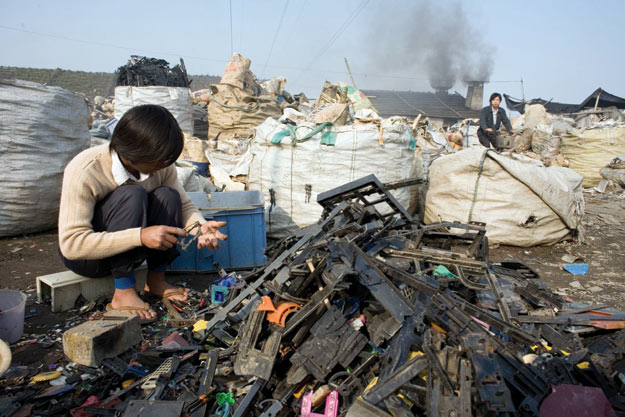
April 2008, Guiyu, China

A woman carries an electronic to be tossed onto a pile in Guiyu, which is, according to several sources, the largest E-Waste dump on earth. 80% of Guiyu's children have elevated levels of lead in their blood.

The purely virtual becomes filthy real.

Saturday, February 19, 2011

Provisional sketch of a new image (part 3)

a) the accident reveals the substance
b) follow the accident
1) Conceive the accident as sign
2) Model the accident onto object in pop narrative

3) Put yourself in the shoes of accident-as-commodity

What is it that the accident says? I've decided to do an experimental sequence of dialogues in which I follow the object through its own narrative and life-span. I figure that providing a narrative might also help us with both Contrast and Theory at the same time, as well as giving voice to the sign came up with in the Target. I may be giving it too many human characteristics, but it's an experiment, so here goes nothing:

Narrative sequence: 1) Birth 2) Life 3) Exile 4) 1st Death 5) Afterlife

1) Taking place sometime after a computer or other electronic device has been brought home:
"Hello, I'm a Macintosh G-5. Turning me on is no problem (just press the button on my back). My protocols have made it super easy for you to get me up and running. Wait, hold on a second, buddy, would you...check...out...that...software!?! Isn't it great!? I know. Oh, what's that? You've never had a computer with a camera before? Check mine out. This is going to be a great relationship. Look, that's you in my screen. You look good; I look good; we'll be good together.

2) Hey man, glad you've been around so much lately. I'm running 6 programs right now (one of them, Transmission, the one you use to pirate those lousy VHS rips of Abel Ferrara television movies, has been on for 4 days straight). I've been running nonstop lately, but I don't mind. I'm digging the attention, to be frank. Aren't you amazed how easy I still am to use? Plug stuff in; I almost immediately recognize it and almost always start the software install before you even have to bother. You've got me set up just the way you like me. Check out how good that screen still from Gilda looks on this HD monitor. You don't know what's inside of me, and that's just fine. Our relationship's deeper than that. Look at these photos you took. Your niece was 14 months old then. She's five now. What a kid!

3) Oh please, baby, please, baby, please babybabyplease! We have a great thing going here! I stopped firing up right away awhile back, but you took me to the right people. My circuits and drives are fine now, baby. Sure, you had to buy a peripheral cd-drive. Did you hear me complaining all of those days you neglected to brush your teeth. Let's face it. You need me. I've been your $*#@&(%@(in' window to the world for 5 years now. You've learned more about yourself on and through me than with anyone else (except your wife...maybe). C'mon, man, get real. I've seen you checking out those Ipads. You think that thing can do what I do for you? C'mon, baby, I love you. I've always loved you! I've never made this relationship anything it isn't. C'mon, let's keep it going. Please.

4) Dear Todd,
That trip across the Pacific was bizarre. You remember that scene from Star Wars (I don't remember which one) where the gold robot goes into the Jawa cruiser thing and sees all of the dismantled robots? That's what this $*#&@#)er is like. I always figured we had a good thing. You should see some of these mean SOBs. Circuit boards pulled apart, wires hanging out, it's like their owners fancied themselves amateur surgeons. Thank God you never pulled on my insides.
All in all, I miss you, but I'm in a fun and exciting new space. We're sitting in a mound full of dirt and trash right now, but I have a bunch of friends from British National Health hangin' with me. I think they're putting up a volleyball net of some sort.
Oop, some kids are coming over. I wonder if they know how to play Tecmo Bowl. Will write back soon.

5) Todd,
A lot has passed since I last wrote. In fact, everything's changed. These kids here use hammers and saws and matches and, well, let's just say I'm a whole new person. Oop, did I say person? Well, kind of. You see, I'm actually punching this message up as I sit in this kid Ke-Zhang's left lung.
Okay, here's the story. Those kids came over and ravaged me. I mean, tore me to shreds. It was the most horrific thing that's ever happened to me. You, you were different. You were gentle with a capital G. No probings on my parts, no investigation into my workings, no nothing. These kids though, holy moly, they ripped me limb by limb and burned some of my coatings off in the fire. I guess I'm worth some money to them, like a fat American just waiting for his kidneys to get jacked.
Oh well, I didn't wake up in a bathtub full of ice.
I'm in a kid's lung.
In fact, I'm settling in.
I got a call from my cousin George. He didn't make it into anybody's lungs, but he's got a sweeter gig. He's moving down to a central water supply.
You see, we all made it. I thought having myself exposed would be the worst. Goodness would dictate that I remain in a strictly screened relationship, but these users, whoa boy, they wouldn't take no for an answer. Anyway, it all worked out in the end. Now, we're merging. They're cool with it. They cough sometimes, but, y'know, they did hammer me apart and set me on fire.
Anyway, I hope you and Steph are okay. I'm having fun and think I'm on to a whole new life now.
Let's just hope it lasts.


Monday, February 14, 2011

Provisional sketch of new image (Parts 1 & 2)

a) the accident reveals the substance
b) follow the accident
1) Conceive the accident as sign
2) Model the accident onto object in pop narrative
3) Put yourself in the shoes of accident-as-commodity

1) E-Waste as sign involves processes of displacement and diffusion. Most of the imagery of E-Waste I've seen are perversely beautiful due to the sheer accumulation of wires, empty computer husks, etc. But its actual method of accident (ecological and biological damage) has primarily involved processes of chemical diffusion: the diffusion of lead, beryllium, cadmium, etc. from the computer products into the lungs of workers and into the earth over which they're burned or otherwise destroyed. The process into a sign must take these things into account. So, we may have a layering of the earth, the biological, and diffusion. Some methods have already been tried at this, some in the right direction and some in the wrong. But now, as a sign, we can develop an abstraction, something reveling in signifiance, something able to get across the obscure feeling, bringing together its obscure desire for us to experience it vicariously. Layering, dissolving, and trailing will be our strategies in this.

2) As I did a few posts ago, the accident is modeled on the object of Vertigo. In that film, Jimmy Stewart attempts to get back many things: his manhood, his balance, his occupation, etc. But all of those things become wrapped up in the love interest, his romantic obsession with the deceased Madeleine. Judy offers him the key to regaining his lost love and all of the symbolic material that comes with her, but the twist is that, as donor, Judy is also the object. Judy eventually encourages Stewart to take her as object, to allow him to wrap her up in his own obsession. At the end of that post, I concluded that E-Waste as sign and computer at object should encourage us to do the same: experience me as object, wrap yourself in my virtuality. Yet the object takes its revenge, infecting our bodies, revealing a different desire: to become one with us. To step outside of its virtuality and to merge somehow. So far, it's been through diffusion.

Sunday, February 13, 2011

A stab at it (maps, etc)


This was another stab at creating an image for the disaster. The elements roughly are: 1) Nature 2) Biology 3) E-Waste 4) Cartography

I like the first image better and was intrigued more by the vertigo of the image from the last post.

Oh well.

Monday, February 7, 2011

The Museum of Accidents as Form


For an experiment, let's re-view Virilio (as though in the rearview mirror) and attempt to see how his choice of narrative form can inform an idea of how to go about structuring the kinds of narrative we will attempt through Contrast.

So, we're back to Target.

Rather than utilizing popular narrative or myth, Virilio employs the museum modality for his gallery of accidents. How does this particular strategy function? How does the choice of the museum-as-exhibition site differ from, say, the movies?

First and foremost, the museum is an institution. Rather than assembling things according to the comparatively loose space of narrative, the museum functions as a site for collecting and exhibiting those works deemed to be of importance to the target culture. So, first and foremost, Virilio institutionalizes the accident.

But then again, as a sign system, how does the museum function?

While exhibitions and installations certainly create and drive according to their own personalities, what the museum typically does is to collect things, to assemble them in some order, to make sense of a given range of work through the act of exhibition.

So, once again, we get back to Virilio's exhibition-as-sign.

In an earlier post, I'd said that Virilio's sign system seems to pose a fixed and fundamental signified for the "raw material" of the accident. To follow-up with Baudrillard's concern over cause and effect, what's interesting about Virilio is that he doesn't seem to be terribly concerned over cause or effect but simply in the sign, in proposing the sign of a particular accident and arranging those signs, raising them to the nth power in succession in order to build to...something (kind of like the blog form, I suppose).

Sure, the individual exhibits have facts about the place, date, size and magnitude of the accident, but if you click on the picture, as if to find out more about it or perhaps to zoom in, we go back to the page we just came from. Depth is not a concern here. Accumulation is presented as a mode of institutional awareness. We'll understand the accident through accumulation, it would seem.

I guess this is where our project might split off. We might take the fundamentals of Virilio's approach (the accident-as-sign, use of images to portray the concepts, etc.), but it seems to me that we're replacing his bare, transparent signified with...something.

Pataphysics? Whatever that is.


Digitized, the museum no longer functions as conscious sketching away of the borders of a collective culture's artifacts but simply as a resting spot for the detritus of a series of images, symbolic without depth, raised to the nth power, put into ecstasy through the mode of accumulation.

Wednesday, January 26, 2011

Provisional Image(s)


Image 1

Image 2

Okay, so here are a couple reachings at figuring out this image.

Working from these images:
Binary Code created on Word

I then put them into my digital camcorder (I like the scan lines) and then put them into Final Cut. Using dissolves, I produced crosses between Forest and Waste, Waste and Videodrome, and Videodrome and the binary. Then, in Photoshop, I layered the images, adjusting opacity and isolating a layer on the right for the hand and binary on the screen.

I then did another version with the E-waste stuff in the foreground and adjusted a bit to allow it more visibility.

Not sure which I prefer. The first one looks better, but the second one has more going on. I'd like to redo this using my own images. I obviously can't produce my own E-waste images, but the forest, a Videodrome-esque shot, and the binary can all be done very easily. So I guess let's consider this a prototype

Sunday, January 16, 2011

Real 1st Post - E-Waste and how to follow

If the last post was a fairly lazy attempt at getting this thing started, let's view this post as an only moderately lazy start. SO, what I intend to do here is to lay down some preliminary research and ideas regarding this accident in an attempt to discern perhaps its technology's essence or its telos --

So, the accident itself is the waste.

What's the waste?

The problem aren't necessarily the materials themselves. A supercomputer or a Cathode-Ray television can be disposed of properly, the more volatile of metals can be removed and sold to procure a profit.

But I'm already getting ahead of myself.

The facts:
Used electronics are being forwarded to developing countries without set standards for how to dispose of various chemically volatile materials. Workers paid very little forced to endure dangerous chemical intake because of "do it quick" procedures made to separate out the precious metals of technologies. So, rather than breaking the machinery down and separating out pieces to be properly disposed, you throw a load of old CPU's onto a fire to melt them down to the inflammable precious metals inside.

So, you end up with phosphor in the air (CRTs), or you're burning plastic to get at something inside of it, forced to huff the fumes.

Are you getting bored yet with facts presented baldly? Here are a couple stills to break it up, from director Tsai Ming-Liang's 2006 film I Don't Want to Sleep Alone:


These images are rather unremarkable, but the reason I include them is that the film, which takes place in Malaysia (the director is Taiwanese, I'm pretty sure), basically starts out as this strange slow piece about sub-poverty urban squatters who come to depend on each other. It's all fine and well-done, but the film takes on this sublime edge when a mysterious fog rolls in over the city about an hour into the movie. There's one hysterically funny and vaguely disturbing scene where two would-be lovers attempt to have sex but, upon trying to take off their masks, break into coughing fits. It probably doesn't sound funny, but, uh, see the movie.

Anyway, basically, this kind of fog can serve as a sort of visual representation of the problem where these fumes spread by the burning of various electronic parts in bonfires is causing major damage to sub-poverty workers and local ecology. It's mostly occuring in large-population countries like China, India, Nigeria, etc. 80% of children in Guiyu, China have elevated levels of lead in their blood due to the improper disposal of electronics there.

The EPA has recommended that consumers simply recycle their goods, and the idea is largely that the solution to the problem lies in our being responsible consumers.
One can see some similarities to prisoner's dilemmas. It's a pain if I have to take an old CRT to Tampa to get it recycled properly. I can just hope that others take the drive to do so, and I'll just toss my junk on the curb. Then again, I just saw two monitors and an old PC sitting on the curb outside my neighbor's place (luckily, several trucks run through my neighborhood every week looking for potentially valuable trash, so it didn't end up in a dump yet...maybe they'll properly dispose of it?).
In the end, doesn't it end up being a matter of ethics?

Anyway, so attempts to solve the problem have largely focused on encouraging responsible recycling of these products (see this list of "E-Stewards") or by encouraging legislation (Responsible Electronics Recycling Act of 2010, Basel Convention).

What I'm wondering is if these methods can curb the tide. We can give all the financial incentives or legal prohibitions we want, but has that turned the tide in other extra-legal practices like the use of sweatshop labor?

It seems to me that the problem is two-fold: 1) It's part and parcel with the general exploitation of the developing world on the part of "1st world" corporate and governmental concerns. 2) It may be a catastrophe endemic to the speed of technological development.

If it's the first, well, man, good luck. We can attempt to develop methods by which to derail these trends (through rhetoric? What form would that take? Activism?).

If it's the second, well, man, good luck again. There's no reversing that tide.

And if we read the problem as being an accident of technology (in this case, let's restrict our focus to the development of computing technologies), then the problem seems even stranger. We might wish for a return to nature of sorts, a move back to the pre-industrial "pure earth." But then again, it also seems as though we're beyond that point. Short of an incredible catastrophe, these things aren't reversing and heading back into the sea. One of the assumptions of electracy is that we're dealing with communications in a post-literate situation...

So, I find that most of my ideas of solutions resemble science fiction for some reason:


Exhibit A) Ghost in the Shell
The premise here is pretty simple. The main characters are government agents who volunteered to turn their bodies into hybrids between corporeality and digital products. As a result, they're hyper badasses. As to be expected, existential questions regarding identity's relation to technology ensues. Highly recommended: plays out like an action film. See it above on youtube links or by DVD from Lib West


Exhibit B: Tetsuo The Iron Man
This one's for adventurous types only. At 60 minutes, this is the fastest paced feature I've ever seen. The concerns are similar to Ghost, but here, it's more involved with industrial products rather than computer-age stuff (so, the difference between hooking your body up to nanobots and hooking it up to industrial products like drills).

Note that both of these are Japanese. Tokyo definitely looks like the city of the future (it's caught up and surpassed the future LA of Ridley Scott's Blade Runner), but what I'm interested in in both of these films are the integration of technology into the human body.

As per the lecture from last week, we're dealing now with a technology that's, well, smarter than us, and if we're to oversee it as operators, the question is how, I guess, that role's to be facilitated. These films (and others like them) suggest that, y'know, we'll eventually integrate these things into our bodies. Of the two, Ghost in the Shell probably has the more interesting ideas about how our bodies interact and deal with technologies (see it, c'mon, it's only like 80 minutes long...)

So, what's the telos? Where do these things all end up? At its current clip, the telos of computing technologies are to move ever and ever further into human communication, determining new automatisms for interactions and relations ("automatisms" in the Cavellian sense, only extrapolated from cinematic codes to vague "communication" tendencies). If that's the essence (maybe), then the accident would be these human-driven poisonings of our natural ecosystem.

So, with this new apparatus, what's the future with this apparatus?

Uh.......