Showing posts with label diffusion. Show all posts

Monday, March 28, 2011

'Pataphysics, Determining the Approach, and Which Science to Use

if poetry cannot oppose science by becoming its antonymic extreme, perhaps poetry can oppose science by becoming its hyperbolic extreme, using reason against itself ‘pataphysically in order to subvert not only pedantic theories of noetic truth but also romantic theories of poetic genius

This strategy of vertigo seems to be becoming more clear. We must look into the science of the topic and exacerbate it in a way that its truth becomes questionable and indiscernible.

The Oulipians derive a logic and strategy from calculus and then derive a way to treat letters and words. Yet the question remains of how one might convert this into a visible syntax, a language made of image.

Do we simply take the words and convert them to image correlates? How do we establish the chain of inference? Something like the figure in the unconscious (something that needs to be traced back to an initial system through processes like displacement and condensation (or, as Lacan says, through metaphor and metonymy?)?

And then the question also comes up of which science to use? If we're to start with a scientific process and then derive an exaggerated poetics out of it, where to look for that science in the accident? For example, with my accident, a primary process is the displacement of lead by way of conflagration of plastics. Do I look into the specific science of that chemical breakdown, convert it to a linguistic trope, and then build that trope into images? Or do I parody the specific science straight off?

Finally, a side note: can we create vertigo just through simply manipulating the user's vision via the Prezi. I've been messing around with the program, and one can easily spin the screen with such convulsions that the viewer might become physically ill. I guess then we can pursue vertigo through both the figurative recognition of ourselves in a mise-en-abyme and also through the visual spinning of an image.

Tuesday, February 22, 2011

Fatal instruction -- final instruction before application

What decision led to the fatal event? What decision, put into contact with an existing desire, launched the fatal accident into the object's becoming?

From Ulmer's last email (see last post): The decision was not to pollute but to trade.
Applied to my context: The decision was not to pollute but to ____.
Calculate? See?
I guess it depends on which element of E-Waste we're talking about.
If we start looking into the history of computing technologies, especially as they applied to Von Neumann in Poundstone, we can see a desire for an object capable of replicating Von Neumann's own, strange, mechanical ability to calculate. So, if we were to go with this thread, we might say that the decision was not to pollute but to calculate. To achieve this then, the materials used in the computer (particularly the non-ferrous metals we talked about before) simply are tools used to enable the connections necessary to manipulate the binary code into something capable of calculating.
But hold on a second. We've so far associated E-Waste with a sense of virtuality, and while the cathode ray technology doesn't define the computer as such, it may act as a successful relay between the computer's functions and our experience of it (an experience defined by the computer's ability to offer us a graphic iconic interface, to display pictures, to act as a window to the world). So, sticking with the cathode ray momentarily, we can see a need emerge.

The historical fatality we can see is the necessity for us to have a relay to the computer's functionality. Punch cards, floppy disks: they're all benign compared to an intrinsic need to see calculation, text, etc. through familiar images.

When you have this need, one can see the necessity of this determination. One had to see. The decision was not to pollute but to see. The involvement of non-ferrous metals (but lead particularly) in the production of the cathode ray tube was simply a technical intervention satisfying a deeper desire. So, therefore, the desire to see fixates on these metals as a means to deliver the object, to intertwine our destiny with its.

Additionally, one can see the problem of E-waste arising from this necessity to see as well. We can see the development of subsequent screens (LCD, LED) as resulting from a desire to see ever more clearly, resulting in the displacement of the CRT and its eventual demise as a figure in a landfill. That isn't to say that these newer technologies solve the problem. A report has indicated that LCD's still contain dangerous amounts of copper and lead. Another indicates about the same for LED screens.

What emblem can stand for this?

Part of my early posts attempted to account for the mixtures of outdated technologies with human desires to see, now expressed in different ways (fetishizing of VHS or cassette tapes in an era of DVD and digital images).
So, from an earlier project that used diffusion as a means to get across the issues of E-waste, perhaps we can add to that a dimension of a kind of seeing that has changed. I.E. IN a new image, we can put in formal elements of former ways of seeing.
My graduate thesis focuses on classical figures by which cinema has been understood (particularly the window and the mirror, the cinema is a ____). My move is to synthesize these forms and posit the cinema as a reflecting window, one that, for example, offers a window onto reality but also that reflects cultural associations, one that offers a window onto the world but also reflects the digital nonsense of pure symbolic, etc. etc.
Perhaps we can utilize this model for the image. The image will offer us a window onto E-Waste but reflect the modes of seeing that have produced the E-waste.
This doesn't change the image much, but it focuses it. From a pure depiction of E-waste, we must now integrate screens (see my "vertigo" image) but also their ability to signify simply as an apparatus.

How can this emblem be manipulated to show the universal subject its own image in the mirror?

We'll see the emblems of E-waste, manipulated to show us texture and diffusion.
But we'll see our mirror image in the scan lines and distortions (simulated, of course) associated with the CRT.

Instruction:

Tap into our fatal need to see that incorporates the poison of the earth. Use the experience of image + the images itself to get across these ideas of seeing oneself in those things that offer images.

As a formal technique, we might see these scan lines as doing something like Holbein's Ambassadors painting:
Lacan writes that this is a prime example because, looking into the image, we eventually see the death's head. This connection will need to be explored more, but I'm starting to intuit its potential.

Let's give it a try.

Saturday, February 19, 2011

Provisional sketch of a new image (part 3)

a) the accident reveals the substance
b) follow the accident
1) Conceive the accident as sign
2) Model the accident onto object in pop narrative

3) Put yourself in the shoes of accident-as-commodity

What is it that the accident says? I've decided to do an experimental sequence of dialogues in which I follow the object through its own narrative and life-span. I figure that providing a narrative might also help us with both Contrast and Theory at the same time, as well as giving voice to the sign came up with in the Target. I may be giving it too many human characteristics, but it's an experiment, so here goes nothing:

Narrative sequence: 1) Birth 2) Life 3) Exile 4) 1st Death 5) Afterlife

1) Taking place sometime after a computer or other electronic device has been brought home:
"Hello, I'm a Macintosh G-5. Turning me on is no problem (just press the button on my back). My protocols have made it super easy for you to get me up and running. Wait, hold on a second, buddy, would you...check...out...that...software!?! Isn't it great!? I know. Oh, what's that? You've never had a computer with a camera before? Check mine out. This is going to be a great relationship. Look, that's you in my screen. You look good; I look good; we'll be good together.

2) Hey man, glad you've been around so much lately. I'm running 6 programs right now (one of them, Transmission, the one you use to pirate those lousy VHS rips of Abel Ferrara television movies, has been on for 4 days straight). I've been running nonstop lately, but I don't mind. I'm digging the attention, to be frank. Aren't you amazed how easy I still am to use? Plug stuff in; I almost immediately recognize it and almost always start the software install before you even have to bother. You've got me set up just the way you like me. Check out how good that screen still from Gilda looks on this HD monitor. You don't know what's inside of me, and that's just fine. Our relationship's deeper than that. Look at these photos you took. Your niece was 14 months old then. She's five now. What a kid!

3) Oh please, baby, please, baby, please babybabyplease! We have a great thing going here! I stopped firing up right away awhile back, but you took me to the right people. My circuits and drives are fine now, baby. Sure, you had to buy a peripheral cd-drive. Did you hear me complaining all of those days you neglected to brush your teeth. Let's face it. You need me. I've been your $*#@&(%@(in' window to the world for 5 years now. You've learned more about yourself on and through me than with anyone else (except your wife...maybe). C'mon, man, get real. I've seen you checking out those Ipads. You think that thing can do what I do for you? C'mon, baby, I love you. I've always loved you! I've never made this relationship anything it isn't. C'mon, let's keep it going. Please.

4) Dear Todd,
That trip across the Pacific was bizarre. You remember that scene from Star Wars (I don't remember which one) where the gold robot goes into the Jawa cruiser thing and sees all of the dismantled robots? That's what this $*#&@#)er is like. I always figured we had a good thing. You should see some of these mean SOBs. Circuit boards pulled apart, wires hanging out, it's like their owners fancied themselves amateur surgeons. Thank God you never pulled on my insides.
All in all, I miss you, but I'm in a fun and exciting new space. We're sitting in a mound full of dirt and trash right now, but I have a bunch of friends from British National Health hangin' with me. I think they're putting up a volleyball net of some sort.
Oop, some kids are coming over. I wonder if they know how to play Tecmo Bowl. Will write back soon.

5) Todd,
A lot has passed since I last wrote. In fact, everything's changed. These kids here use hammers and saws and matches and, well, let's just say I'm a whole new person. Oop, did I say person? Well, kind of. You see, I'm actually punching this message up as I sit in this kid Ke-Zhang's left lung.
Okay, here's the story. Those kids came over and ravaged me. I mean, tore me to shreds. It was the most horrific thing that's ever happened to me. You, you were different. You were gentle with a capital G. No probings on my parts, no investigation into my workings, no nothing. These kids though, holy moly, they ripped me limb by limb and burned some of my coatings off in the fire. I guess I'm worth some money to them, like a fat American just waiting for his kidneys to get jacked.
Oh well, I didn't wake up in a bathtub full of ice.
I'm in a kid's lung.
In fact, I'm settling in.
I got a call from my cousin George. He didn't make it into anybody's lungs, but he's got a sweeter gig. He's moving down to a central water supply.
You see, we all made it. I thought having myself exposed would be the worst. Goodness would dictate that I remain in a strictly screened relationship, but these users, whoa boy, they wouldn't take no for an answer. Anyway, it all worked out in the end. Now, we're merging. They're cool with it. They cough sometimes, but, y'know, they did hammer me apart and set me on fire.
Anyway, I hope you and Steph are okay. I'm having fun and think I'm on to a whole new life now.
Let's just hope it lasts.


Monday, February 14, 2011

Provisional sketch of new image (Parts 1 & 2)

a) the accident reveals the substance
b) follow the accident
1) Conceive the accident as sign
2) Model the accident onto object in pop narrative
3) Put yourself in the shoes of accident-as-commodity

1) E-Waste as sign involves processes of displacement and diffusion. Most of the imagery of E-Waste I've seen are perversely beautiful due to the sheer accumulation of wires, empty computer husks, etc. But its actual method of accident (ecological and biological damage) has primarily involved processes of chemical diffusion: the diffusion of lead, beryllium, cadmium, etc. from the computer products into the lungs of workers and into the earth over which they're burned or otherwise destroyed. The process into a sign must take these things into account. So, we may have a layering of the earth, the biological, and diffusion. Some methods have already been tried at this, some in the right direction and some in the wrong. But now, as a sign, we can develop an abstraction, something reveling in signifiance, something able to get across the obscure feeling, bringing together its obscure desire for us to experience it vicariously. Layering, dissolving, and trailing will be our strategies in this.

2) As I did a few posts ago, the accident is modeled on the object of Vertigo. In that film, Jimmy Stewart attempts to get back many things: his manhood, his balance, his occupation, etc. But all of those things become wrapped up in the love interest, his romantic obsession with the deceased Madeleine. Judy offers him the key to regaining his lost love and all of the symbolic material that comes with her, but the twist is that, as donor, Judy is also the object. Judy eventually encourages Stewart to take her as object, to allow him to wrap her up in his own obsession. At the end of that post, I concluded that E-Waste as sign and computer at object should encourage us to do the same: experience me as object, wrap yourself in my virtuality. Yet the object takes its revenge, infecting our bodies, revealing a different desire: to become one with us. To step outside of its virtuality and to merge somehow. So far, it's been through diffusion.

Provisional sketch of new image (parts a & b)

a) The accident reveals the substance
b) Follow the accident
1) Conceive of the accident as a sign
2) Model the accident as object onto a pop-narrative
3) Put yourself in the shoes of the accident-as-a-commodity

a) E-Waste tells us something about the computer and our relationship to it (its technics). Its fundamental mystery (we have yet to tangibly experience it or its results) is that E-Waste has nothing to do with our experience of the computer-as-machine. As a machine, it provides us with a virtual interface, an interface represented by (at least) a double negation.
First, our interfacing with the machine presents us with iconographic registers that are instantaneous with our interaction and manipulation of them. Its essential work, of course, takes place at the level of code. Second, this code itself remains a virtual network, entirely supported by a purely symbolic system of notation having no relationship with the referent. But this code itself only works as a result of the various tangible parts of the machine, parts that produce certain chemical reactions to fire electronic messages in and through lines.
E-Waste reverses the order, stopping short before the first negation can be reached. Unwired and cut off from our normal relationship, we see the obscenity of the machine, smashed into bits, and this is where the machine has its revenge. It allows us to see its insides but only at the price of ecological and biological damage, conveniently displaced from first world consumers to third world scrap-metallers.

b) So what we're left with is another kind of displacement or negation. The machine is used, used until it quits (or until we quit it). We tell the machine, "I got what I wanted, baby, hit the bricks!" And it does, moving on to new users but eventually being pressed to other areas who can employ its physical material, themselves having value on a virtual level (so, a kilo of copper might fetch some $$$). We're there seeing the more virtual than virtual, of course lapsing into its reverse state: the real, or reality. From these compounded virtual relationships, real consequences develop...for some. This may not be just the limit for the particular object but may be considered the limit for a larger virtuality, the ones of exchange (reaping all sorts of ecological havoc) and of interfacing (disconnecting us further from the real). But let's see how much further it can go.

Thursday, January 27, 2011

Science Time!

So, Ulmer confronted me with what had been my great laziness so far. Because I'm interested mostly in the geopolitical and philosophical ramifications something like E-waste holds, I've found myself less curious about investigating the hard science behind the issue. So, here, I'd like to look at a few ways in which the problem actually, y'know, is a problem.


So, first, let's look at chemical and biological damage. This is kind of the first and foremost concern (we'll look at some of the geopolitical specifics in a moment).

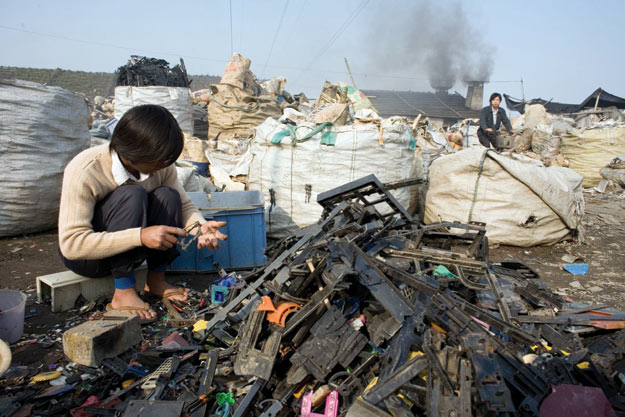
So, the most drastic and attention-grabbing of the E-waste victims have been the children in an area of China called Guiyu where the hazardous disposal of plastics in computers and other parts (for example, workers there burn piles of wire to melt off the protective cover and to grab out the copper from inside) has resulted in something like 80% of their children having "dangerous levels of lead in their blood." The problem comes when these heavy metals are burnt down and put into the air that's then breathed in by workers involved in improper disposal (this article paints a pretty bleak, if somewhat sensationalized, picture of the situation). One finds the same problem when a CRT tube is smashed, which often sends Beryllium fumes into the air, which, of course, are carinogens and can cause, y'know, cancer.

So what can lead do? If inhaled, it can be diffused in one's blood or tissues where it can move, at the level of an enzyme, and, because of its similar appearance to other biologically-necessary metals, can change the shape of the development of blood and neurons, which obviously causes problems, y'know, with the other parts of the body that depend on these things. That's why some people suffering from lead poisoning report increased aggressivity or other psychological or social maladies.
So, we also have to deal with land contamination, most prominently in the figure of dioxins soaking into soil as a result of the burning of these unstable products. These can result in liver and developmental issues if not, again, carinogetic damage. If an area of land is polluted, problems might not arise from direct contact, but with enough exposure (and especially if animals become infected), things can get ugly pretty fast.
So, finally, I guess we'll have to reckon with the geopolitical aspects of the accident. The story I reference above traces the dumped computers in Ghana to England's NHS (they left the stickers right on the things). I'll have to take some more time to dig into these cases, but it seems as though its general logic is similar to the accidents Ulmer's dealing with in which a group decides to dump products because it's cheaper than disposing of it properly. Here though, we have an extended issue in that we have a group of countries basically scuttling these hazardous materials off to developing nations in the hopes that their indigenous populations will take apart the machinery for the precious metals rather than reporting the damage to anyone else.
Ugh, that felt like a pretty half-assed attempt at science. Will have to get back to this another time...


Wednesday, January 26, 2011

Provisional Image(s)


Image 1

Image 2

Okay, so here are a couple reachings at figuring out this image.

Working from these images:
Binary Code created on Word

I then put them into my digital camcorder (I like the scan lines) and then put them into Final Cut. Using dissolves, I produced crosses between Forest and Waste, Waste and Videodrome, and Videodrome and the binary. Then, in Photoshop, I layered the images, adjusting opacity and isolating a layer on the right for the hand and binary on the screen.

I then did another version with the E-waste stuff in the foreground and adjusted a bit to allow it more visibility.

Not sure which I prefer. The first one looks better, but the second one has more going on. I'd like to redo this using my own images. I obviously can't produce my own E-waste images, but the forest, a Videodrome-esque shot, and the binary can all be done very easily. So I guess let's consider this a prototype

Sunday, January 23, 2011

In Rethinking...


In rethinking my image, I've been thinking about how Dr. Ulmer characterized modernist painting last week. He said it has to do with kinds of fundamental motions. I'll take a stab at expanding that and say that it depends on the motion of the world. One of the things I find remarkable about cinema is how it can show us the play of the world on bodies. So, the majesty of Chaplin in The Pawn Shop is seeing a man absolutely master gravity (see, especially, the bit with him on the ladder, a moment emblematic of the cinema itself).

Anyway, what I'm trying to do with the image is to represent the natural world, its destruction via e-waste, and the simultaneous existence of memory in digital interfaces, themselves underlain by what seems like senseless computation.

I've come upon the idea of diffusion.

When I think of E-waste, I think of the burning of these material products and of the diffusion of their being into the air and finally into the lungs of nearby workers and flora/fauna.

When I think of the transition to electracy, I think of a subtle diffusion from one state to another (not a catastrophe but a slow but sure change...I think my generational positioning is rather unique because we got our first computer when I was an adolescent, so I have the memories of a computer-free childhood and kind of grew up into computing, I guess).

When I think of the process of these products being distributed to developing countries, I think of a diffusion of information. We catch mists of this insanity but only briefly feel it on our face, like a soft wind that, as it comes at us with thousands of winds, often feels like a maelstrom.

Oh God, I'm waxing poetic. Time to wrap this one up.

So: Elements: Nature, Waste, Wind, GUI, code. Logic: Diffusion. Means: Dissolves.

Coming soon.